Stock markets often drift during the summer months. Volatility is usually lower, but liquidity thins out as investors head off on their holidays. That means sudden market-moving events - corporate earnings announcements, central bank policy shifts or, as we've seen recently, geopolitical tensions - can trigger bigger, sharper market moves.
The first half of 2026 has been anything but stable for stock markets around the world. A series of geopolitical shocks has coincided with surging investment in AI, strong corporate earnings and solid US economic growth. Risk assets have held up well through all of this, but the danger for investors is mistaking resilience for calm.
So far this month, we've seen a decisive rotation out of mega-cap technology stocks and into other sectors. In short, parts of the technology sector - including semiconductors - have run too far, too fast and are now giving back some of those gains. In our view, the fundamentals remain intact, with strong revenue, earnings and backlogs, but some of that good news may already be baked into share prices.
Still, if the corporate earnings season meets its lofty forecasts and outlook statements stay upbeat, technology could take the lead again - particularly in the parts of the market that have lagged most. Over the next couple of weeks, all eyes will be on those Q2 earnings announcements and the forward guidance from senior management.
The direction of crude oil prices will matter too. They've spiked significantly since the collapse of the US-Iran ceasefire and the resumption of hostilities, reigniting inflation worries and raising the possibility that the US Federal Reserve may need to think about raising interest rates again. This has renewed demand for the US dollar and, alongside the sell-off in US and Asian technology stocks, has added to short-term weakness in Asian and emerging stock markets.
Last week saw a pullback in markets, particularly in tech. That said, some sharp-eyed traders appeared to treat the dip as a buying opportunity, with options activity pointing to dip-buying in selected semiconductor names and some rotation into less crowded corners of the market.
The week leading up to 17 July marked a clear shift in mood: from wide-eyed AI enthusiasm to a more selective focus on corporate earnings, cash flows and geopolitical risk - which is particularly acute for export-driven Asian markets.
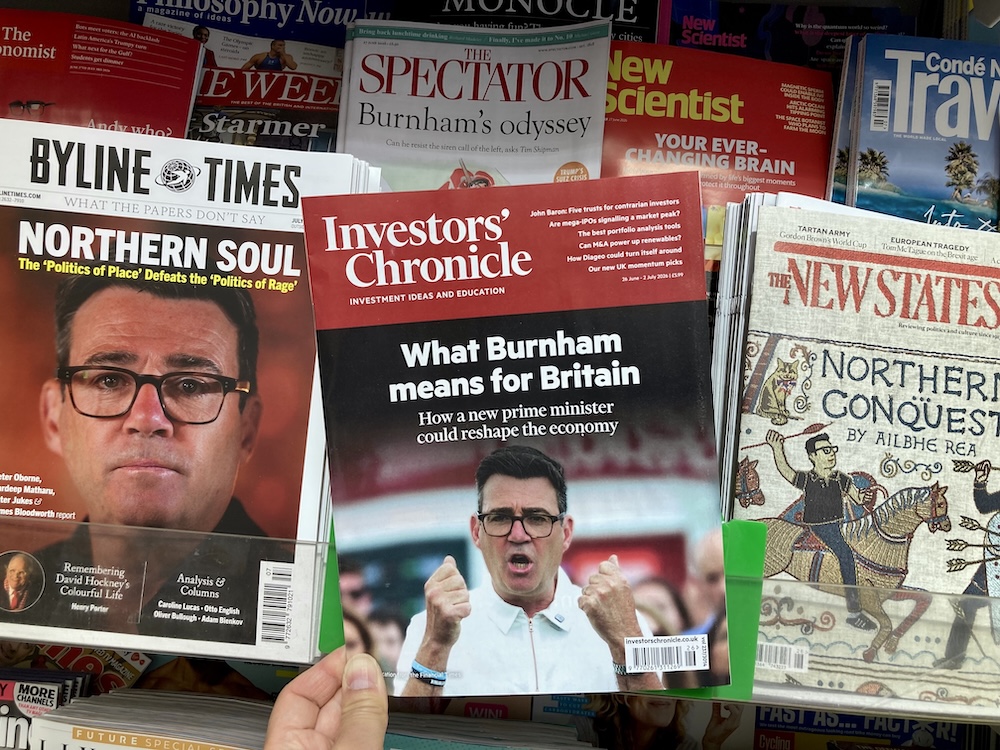
In Europe, inflation across the eurozone fell to 2.8% in June - its lowest since the start of the US-Iran war. In the UK, meanwhile, attention has turned to domestic politics and the handover from Sir Keir Starmer to Andy Burnham.
As expected, the UK returned to growth in May. The focus now shifts to Andy Burnham's new cabinet and the policies he plans to bring in. His agenda includes "Manchesterism" - devolving power away from Whitehall - reindustrialising the north and delivering swift cost-of-living support. He has vowed to correct what he sees as the wrong turns the UK took under Margaret Thatcher in the 1970s, and which previous Labour governments failed to undo. It's worth remembering, though, that the UK economy didn't prosper in the 1970s. The decade was marked by high inflation, rising unemployment, frequent strikes and slow growth, ending in an IMF bailout in 1976. Although real household incomes rose overall, the period is widely seen as one of economic difficulty and stagnation. Let's hope the UK under Burnham doesn't resemble the 1970s in every respect.
On taxation, Andy Burnham wants to devolve more tax-raising powers to local and regional authorities and use the tax system to support investment, reduce regional inequalities and strengthen public services, rather than relying on centrally directed economic policy. He has pledged no increases to income tax, VAT or employee National Insurance, but supports higher capital gains tax, a land value tax, and reforms to council tax and inheritance tax to fund social care and cut business rates for small firms.
This raises an important question: will more wealthy individuals leave the UK? Record outflows were seen in 2025, as millionaires headed for Dubai, Switzerland and Singapore, driven by higher taxes, the abolition of non-dom status and rising living costs.
Overall, global equity markets have still had a solid year, despite geopolitical uncertainty and rotation within the technology and AI sectors. The S&P 500 Index is up about 10% for the year, following three years of double-digit gains. Rotation beneath the surface is likely to continue, but the good news is that investor appetite for equities remains strong. Predicted corporate earnings growth and confidence in the strength of the US economy suggest this backdrop could persist.
Elsewhere, we continue to prefer Asia and emerging markets over Europe. Emerging markets are widely expected to keep outperforming developed markets over the next 12 months, supported by Fed easing, a weaker US dollar, attractive valuations, stronger GDP growth and favourable demographics. That said, performance is likely to stay selective across regions, with geopolitical risk and policy credibility acting as the key differentiators.
Perhaps more importantly, Wall Street analysts broadly expect positive investment returns in 2026, with median S&P 500 Index targets implying a roughly 10% to 12% full-year gain. This outlook is being driven by AI spending, tax cuts and anticipated Fed rate cuts. Even so, elevated valuations and political risks could still make for a bumpy ride.

