

For many couples, Inheritance Tax (IHT) isn't something that might happen one day - it's something that almost certainly will. Once your estate sits comfortably above the available allowances, the question shifts from "will there be a bill?" to "how will our family actually pay it?", and a Whole of Life policy written on a joint life, second death basis is one of the most effective ways to deal with that.
Inheritance Tax is charged at 40% on everything in your estate above your available allowances. Each person has a nil-rate band of £325,000, which means a couple can pass on up to £650,000 between them before any IHT becomes due. There's also a residence nil-rate band of up to £175,000 each where the family home passes to children or grandchildren, but it isn't something you can rely on - it tapers away once an estate goes above £2m, so larger estates often lose it altogether. The nil-rate band itself can shrink too, because any gifts made in the seven years before death are set against it first. Once you strip out the allowances that may or may not apply, a sizeable estate is left staring at a 40% bill that's all but inevitable, and that's exactly the kind of liability a policy is built to meet.
And this is only becoming a bigger issue. The allowances have been frozen for years while property and investment values have kept climbing, which has quietly pulled more families over the threshold without them realising. From April 2027, unused pension funds will also be drawn into the estate for IHT - assets that until now have sat safely outside it. Put those shifts together and more people than ever are heading towards a bill that's larger than they were expecting.
From April 2027, the government expects around 10,500 additional estates to pay IHT, and around 38,500 to pay more than they had before (GOV.UK, July 2025).
A Whole of Life policy is guaranteed to pay out, which is what sets it apart from most other types of cover. There's no fixed end date, so as long as the premiums keep being paid, a claim is certain to come at some point. Written on a joint life, second death basis, it insures both partners together and pays a single lump sum on the second death, which is the exact moment the IHT bill on your combined estate falls due.
That timing is really the whole point of the structure. Instead of leaving your family scrambling to find a large sum at the worst possible time, the policy puts the right money in their hands at the exact moment HMRC comes asking. The sum assured is sized to match your expected liability, which means the cover is built around your estate rather than picked off a shelf, and by the time the bill arrives the money to settle it is already sitting there ready.
What really makes it effective is the way the money is paid out. Set up properly, the policy is written in trust, so the proceeds sit outside your estate and pass to your beneficiaries free of all tax - no IHT, no deductions, no chunk lost on the way through - meaning every pound goes towards settling the bill rather than back to HMRC. And because the policy is held in trust, the payout can usually be made directly to the beneficiaries without waiting for a Grant of Probate, so they aren't stuck in limbo while the paperwork is sorted out.
Ultimately, that's what the cover is there to protect. Picture children inheriting a much-loved family home: without the cash to hand to pay HMRC, they could be forced into selling it simply to settle the tax. With a policy in place, the bill is paid from the trust instead, and the home, or a business, or whatever else matters most, stays in the family fully intact.
It's a question worth digging into properly. The obvious alternative to paying premiums is to hold onto that money in your estate and invest it instead, but there are two problems with going down that route:
The table below works this through for a couple, both aged 60, taking out £1m of joint life second death cover at a premium of £12,720 a year. It compares the guaranteed £1m payout against what those same premiums could grow to if invested instead, shown at both 4% and 6% annual growth, and after stripping out the 40% IHT that would be due on the invested pot.
Even achieving a steady 6% return every year, the invested pot wouldn't match the £1m the policy pays from day one until the couple reached 96. At a more modest 4% return, they'd have to make it to 105 before the invested pot caught up. And those growth rates aren't guaranteed in the first place - they'd need to be achieved after all costs and charges, plus any drag created by tax due during the couple's lifetime.
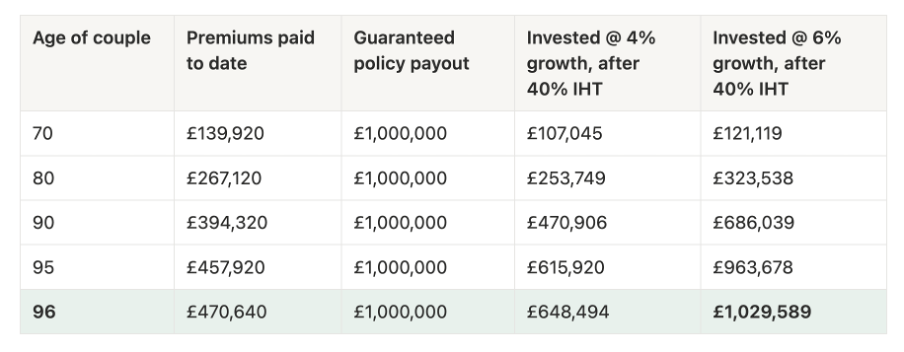
The real point here is when the money is needed. The whole reason to insure in the first place is the risk of dying earlier than expected, and that's precisely where the policy proves its worth. If the second death happens at, say, 70 or 80, the family receives the full £1m tax-free, having paid only a fraction of that in premiums along the way. The invested alternative would still leave them well short, and what was there would be further reduced by IHT.
It helps to stop thinking of this as life insurance and to see it instead as a savings plan that happens to pay out free of IHT. Where an ordinary investment carries risk and an uncertain return, a Whole of Life policy doesn't. The policy is guaranteed to pay, and you know from the outset exactly what your family will receive.
For a couple facing an unavoidable Inheritance Tax bill, that turns a looming, uncertain liability into a known and manageable annual cost, with a tax-free sum landing in the hands of the people who need it at exactly the right moment. Far from a gamble, this is a considered and deliberate piece of planning - a tax-efficient structure designed to make sure the money is there when it really counts.
This article is for general information only and does not constitute financial advice. Tax treatment depends on individual circumstances and may change in the future. Investment returns are not guaranteed and the value of investments can fall as well as rise. Premium and projection figures are illustrative and based on the example modelled for a couple aged 60.
